KEY TAKEAWAYS:
- The CM Vijay 5 shows a day rule removes the requirement for producers to seek police or district collector approval for extra screenings during a film’s first week.
- A major box office boost for Kollywood is expected, as estimates suggest a single extra show can generate over ₹1.4 crore in revenue across a seven-day run.
- Theater owners can now implement a new Tamil film release schedule that includes five guaranteed daily slots for the first week, weekends, and public holidays.
- Navigating theatre owners’ licensing issues becomes easier under this directive, as the 1957 rule requiring separate permits for fifth shows has been amended.
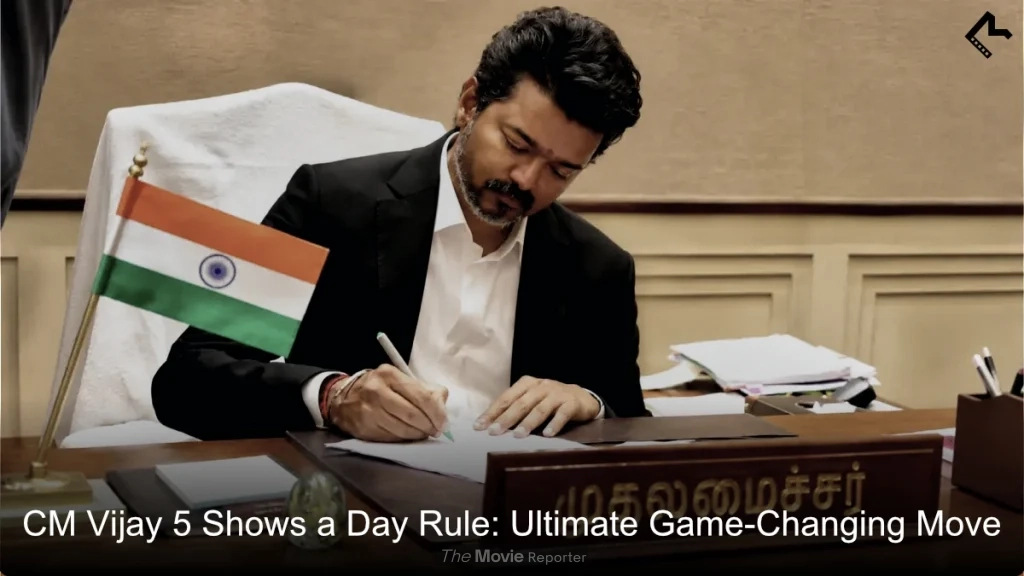
A mid-sized Tamil film can generate an extra ₹1.4 crore in revenue in just one week because of a single daily screening. This massive financial swing is the direct result of the CM Vijay 5 shows a day rule, which completely changes how films open in Tamil Nadu. By allowing five daily shows for the first seven days of a release, the government has eliminated the red tape that previously stifled theater revenue. Producers no longer need to beg for special permissions.
What is the CM Vijay 5 shows a day rule?
The current state government has fundamentally altered the theatrical landscape by amending decades-old regulations that limited how often movies could play. Under this new directive, any newly released Tamil film is now entitled to five scheduled shows daily from the day of its release for seven consecutive days. This isn’t just a temporary measure for a few blockbusters; it’s a standing policy that applies to every new Tamil film release.
Here’s where it gets interesting for theater owners and fans alike. The rule extends beyond the initial week, granting five shows on all weekends, festive holidays, and government holidays throughout a film’s entire theatrical run. By codifying the CM Vijay 5 shows a day rule into law, the administration has removed the administrative burden that used to fall on theater owners. You’ll no longer see distributors scrambling for last-minute approvals because the permission is now automatic.
It’s a bold departure from the previous standard where theaters were strictly capped at four shows a day. Previously, if a producer wanted a fifth “special show,” they had to navigate a complex bureaucratic maze. The new order simplifies everything by stating that these extra screenings no longer require separate clearances from the government or licensing authorities. This policy essentially hands the power of scheduling back to the exhibitors and producers who understand the market demand best.
Tackling theatre owners’ licensing issues
Solving theatre owners’ licensing issues was a central motivation behind this legislative update after industry representatives met with the Chief Minister on May 16. For years, the industry operated under Rule 14-A of Form C of the Tamil Nadu Cinemas (Regulation) Rules of 1957. These antiquated rules were designed for a different era of film exhibition and often forced owners to chase District Collectors or Police Commissioners for every single extra screening.
Owners in smaller towns faced the toughest hurdles because they lacked the resources to manage constant administrative filings. Under the new system, the three-year licensing period and the removal of project operator licenses—since all theaters are now digital—further modernize the sector. By eliminating the need for case-by-case approvals, the government has cleared a major bottleneck that once led to lost revenue. This shift allows even small single-screen operators to compete more effectively during high-demand release windows.
Why this creates a box office boost for Kollywood
- Direct Revenue Growth: A single additional show for a mid-sized film on 1,000 screens can generate roughly ₹20 lakh in a single day.
- Opening Week Maximization: The first seven days are when production companies recover the largest share of their investment.
- Rights Valuation: A stronger box office boost for Kollywood in the first week directly increases the value of OTT, satellite, and music rights packages.
- Scalability for Blockbusters: For massive releases on 2,000+ screens, the financial gains from a fifth show scale dramatically higher than for mid-range films.
- Risk Reduction: Guaranteed screening slots during the most critical commercial period reduce the overall risk for film financiers.
These factors combine to create a structural advantage for the entire industry. Sound familiar? You’ve probably seen theatres struggling to manage massive crowds during opening weekends when they were limited to just four shows. Now, that extra capacity ensures that the peak demand is met while it’s at its highest. This isn’t just about ticket sales; it’s about the health of the entire cinematic ecosystem.
The financial significance of the CM Vijay 5 shows a day rule is hard to overstate. When a film has an average occupancy of 50 percent in a 200-seat hall at a ₹200 ticket price, the math adds up fast. Over a seven-day run, that single extra show pushes total earnings up by more than ₹1.4 crore. This policy effectively recovers money that was previously left on the table due to scheduling restrictions.
How to schedule 5 shows in TN theatres?
How do theater managers actually fit five screenings into a single day without breaking the law? The answer lies in the relaxation of the 1973 Home Department orders that previously restricted screening hours to between 9 a.m. and 1:30 a.m. the following day. While first shows traditionally began no earlier than 9 a.m., the new directive provides the flexibility needed to accommodate the logistics of modern film lengths.
A major challenge in the past was fitting a long film, such as one running 2 hours and 45 minutes, into a five-show schedule. When you factor in audience entry and exit, intervals, and cleaning time, a five-show cycle can take over 18 hours to complete. The CM Vijay 5 shows a day rule provides the legal framework to manage these tight windows without fear of receiving a notice from the Police Commissioner. By removing the requirement to obtain separate permissions, managers can now plan their daily rotations with much greater certainty.
The transition to this new format allows for more creative scheduling around peak hours. Instead of being stuck with rigid blocks, theaters can now optimize their screen usage to ensure every showtime is profitable. This flexibility is essential for sustaining theaters in the long run, especially as they face rising operational costs and competition from streaming platforms.
Adapting to the new Tamil film release schedule
Implementing a new Tamil film release schedule is now a standardized process for every distributor in the state. Every film is automatically entitled to its five shows for the first week, which takes the guesswork out of the initial rollout. This entitlement also kicks in for every Saturday and Sunday, even after the first week has passed.
This change allows producers to plan their marketing around a guaranteed number of screens and showtimes. Previously, the uncertainty of getting a fifth show meant that revenue forecasts were often unreliable. Now, the industry can operate with a clearer “what/why/how” guide for every release, knowing that the regulatory hurdles have been cleared in advance.
Concrete Examples of the Policy in Action
Take the release of ‘Karuppu’, starring Suriya and Trisha Krishnan, as a prime example of the Chief Minister’s intent. Earlier, the CM personally intervened to allow a 9 a.m. morning show for the film, which was a signal of the industry-friendly policies to come. ‘Karuppu’ went on to show strong box office performance, crossing ₹200 crore worldwide. That decision served as a pilot for the standing policy we see today.
Another fascinating scenario involves the upcoming film ‘Jana Nayagan’, which is touted to be the final film of the actor-turned-CM. The film has faced significant delays from the revision committee and the CBFC due to its political content. When ‘Jana Nayagan’ eventually hits screens, it will be one of the major beneficiaries of the CM Vijay 5 shows a day rule. The industry is closely watching how this policy supports such big-budget, high-demand releases.
Consider the case of ‘Leo’, where the producer had to move the Madras High Court just to seek permission for early morning shows. The producer argued that fitting five shows of a long film into the state-prescribed timeframes was nearly impossible without an earlier start time. The court eventually directed the state to reconsider its stance, highlighting the friction inherent in the old system. The new rule aims to prevent these legal standoffs by providing a clear, uniform standard for everyone.
How This Compares to the Old Way
- Approval Process: Previously, theaters needed explicit permission from the District Collector or Police Commissioner for a fifth show; now, it is an automatic entitlement for the first seven days.
- Rule 14-A Limitations: Under the 1957 rules, cinema halls were strictly limited to four daily shows, whereas the new amendment permits five shows as the new standard for releases and holidays.
- Special Show Restrictions: Fifth shows used to be reserved only for festive holidays or public holidays; today, they are permitted for the entire opening week and every weekend thereafter.
- Administrative Burden: The old system was described as a “tedious process” that many smaller theaters couldn’t manage, while the new directive eliminates the need to chase local authorities entirely.
The Bottom Line
The CM Vijay 5 shows a day rule represents a fundamental shift in the economic structure of the Tamil film industry. By removing 1957-era bureaucratic hurdles and guaranteeing screening slots during a film’s most profitable window, the government has provided producers with a vital structural advantage. This move does more than just boost initial ticket sales; it enhances the valuation of all secondary rights and reduces investment risk for financiers. As the industry adapts to this new level of freedom, we may see even larger production budgets and improved theater infrastructure across the state. This policy ensures that Kollywood’s theatrical culture remains robust in the face of modern challenges.